
Advanced radiant ceiling cooling system

Published research Dec 2025

Overview

This project evaluated an advanced radiant ceiling cooling configuration for office buildings in hot and humid conditions, with emphasis on both system efficiency and indoor thermal comfort.
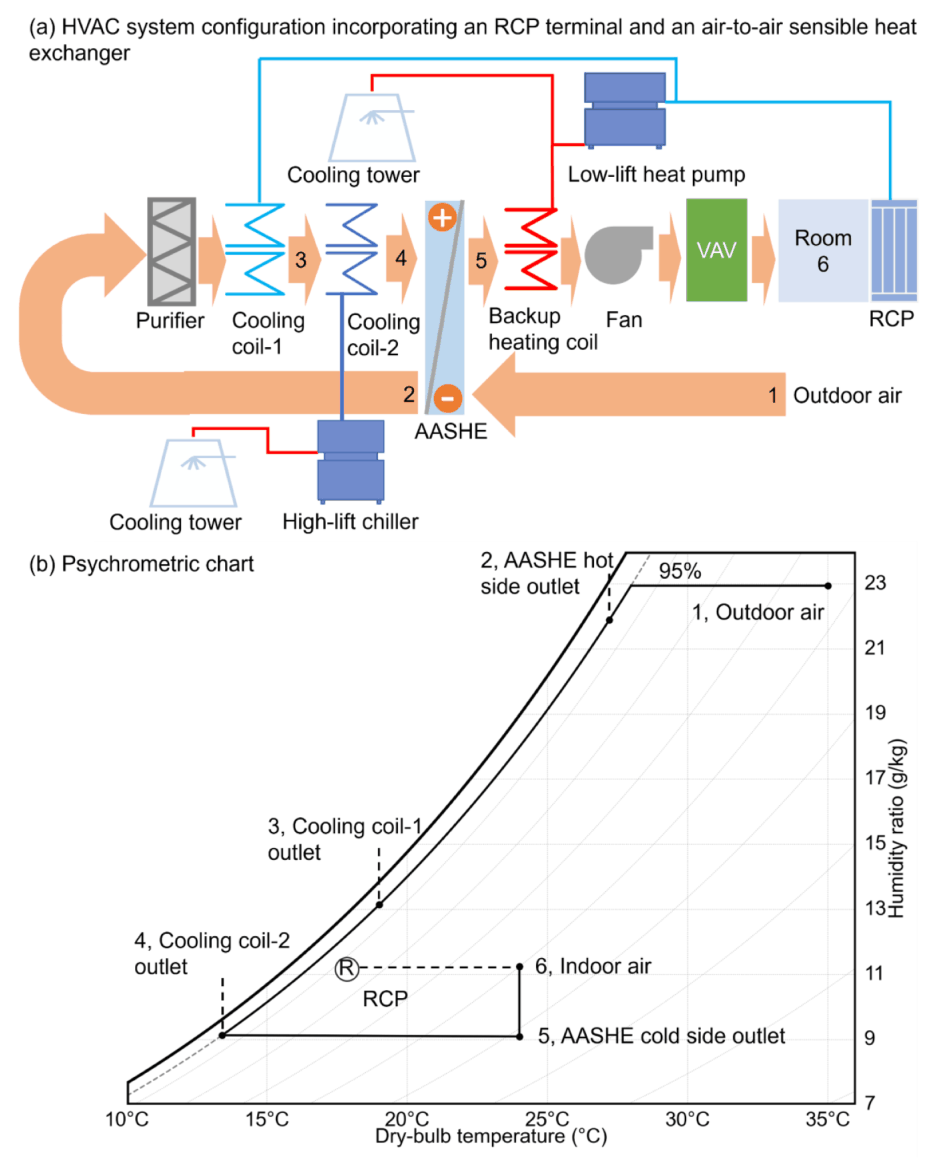
Schematic of the HVAC configuration combining a radiant ceiling panel with an air-to-air sensible heat exchanger, paired with the corresponding psychrometric chart.
The proposed configuration: radiant ceiling panels served by a dedicated outdoor-air system with an air-to-air sensible heat exchanger, and its air-treatment process.

Method

The proposed system coupled radiant ceiling panels and a dedicated outdoor-air system with an air-to-air sensible heat exchanger. EnergyPlus simulation, exergy analysis, dehumidification-temperature optimization, and variable-air-volume control were used to compare the design with a conventional fan-coil system.
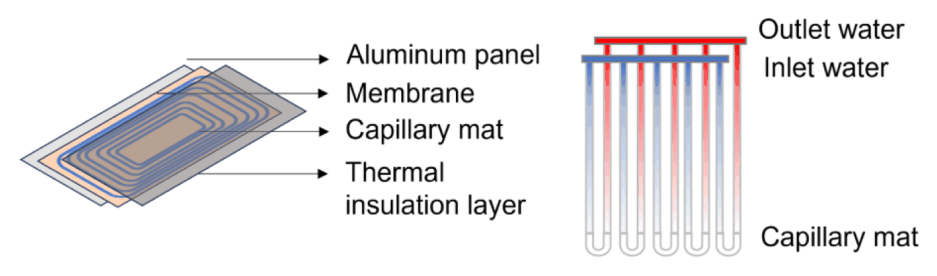
Exploded view of a radiant ceiling panel showing the aluminum panel, membrane, capillary mat, and thermal insulation layer.
Construction of the radiant ceiling panel and its capillary mat.
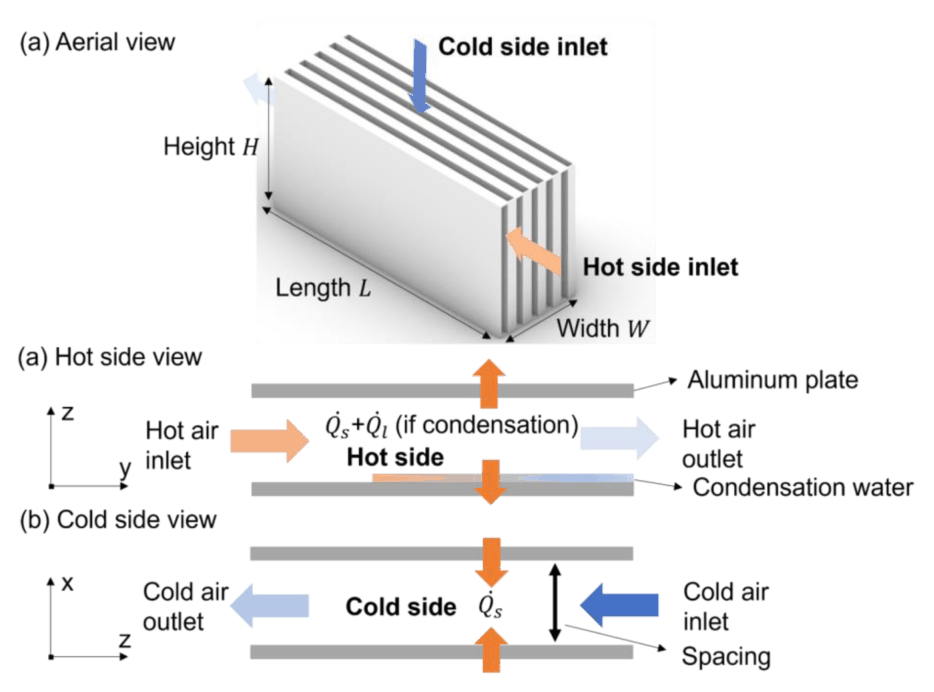
Aerial, hot-side, and cold-side views of the air-to-air sensible heat exchanger with airflow and condensation paths labelled.
The air-to-air sensible heat exchanger, which reheats supply air without additional energy input.

Key findings

The proposed configuration reduced the indoor discomfort ratio from 54.0% to below 0.8%, lowered total energy use by 19.8%, and increased exergy efficiency from 16.1% to 21.1% relative to the original fan-coil system. The results demonstrate how passive reheating and load shifting can improve radiant cooling in dense, hot-humid office environments.
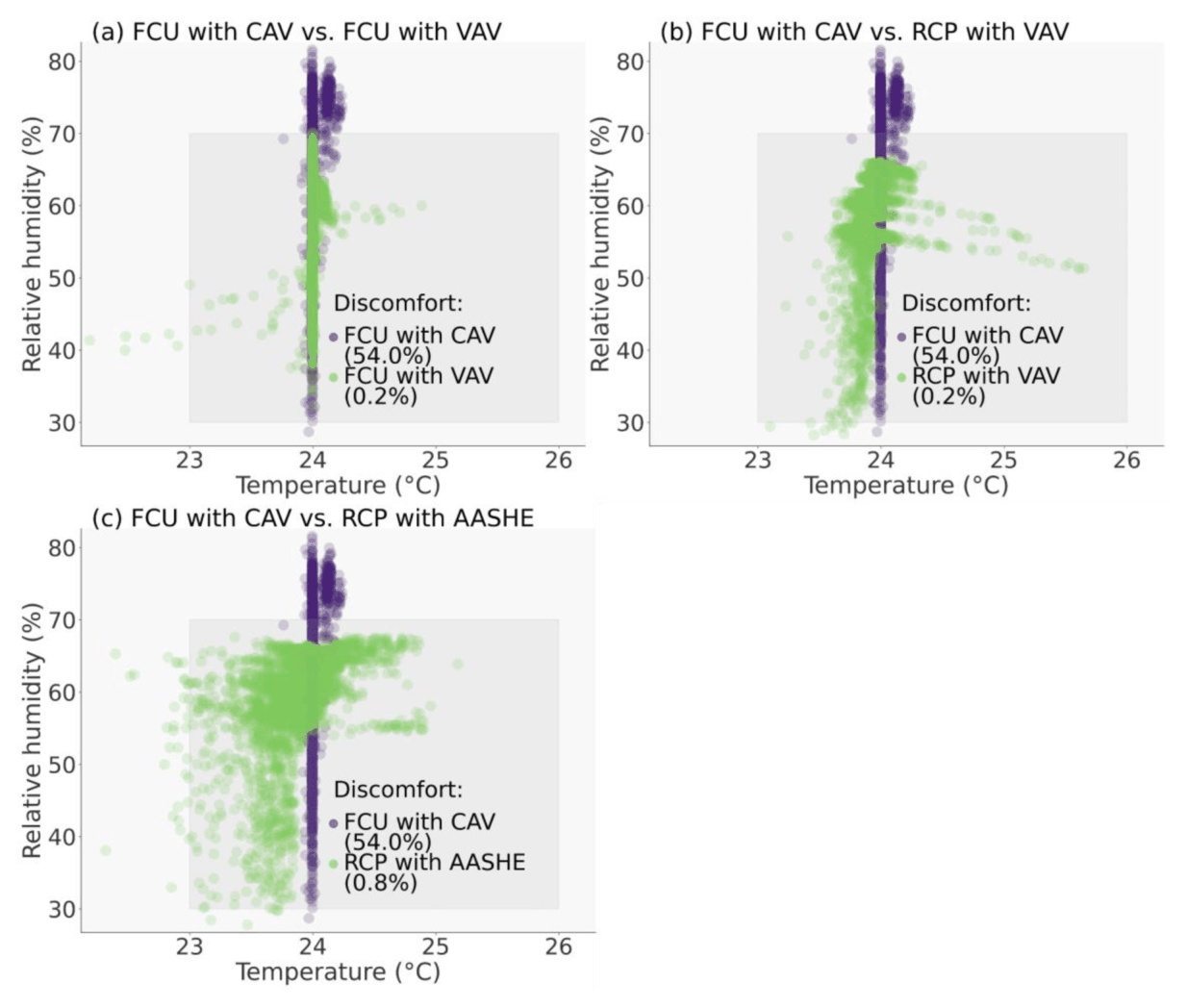
Scatter plots of indoor temperature against relative humidity for three system configurations, with the comfort zone shaded and discomfort ratios falling from 54.0 to 0.8 percent.
Indoor conditions across the three configurations; the proposed system holds the discomfort ratio at 0.8%.

Contribution

Conceptualization, data curation, methodology, software, visualization, and original-draft writing.